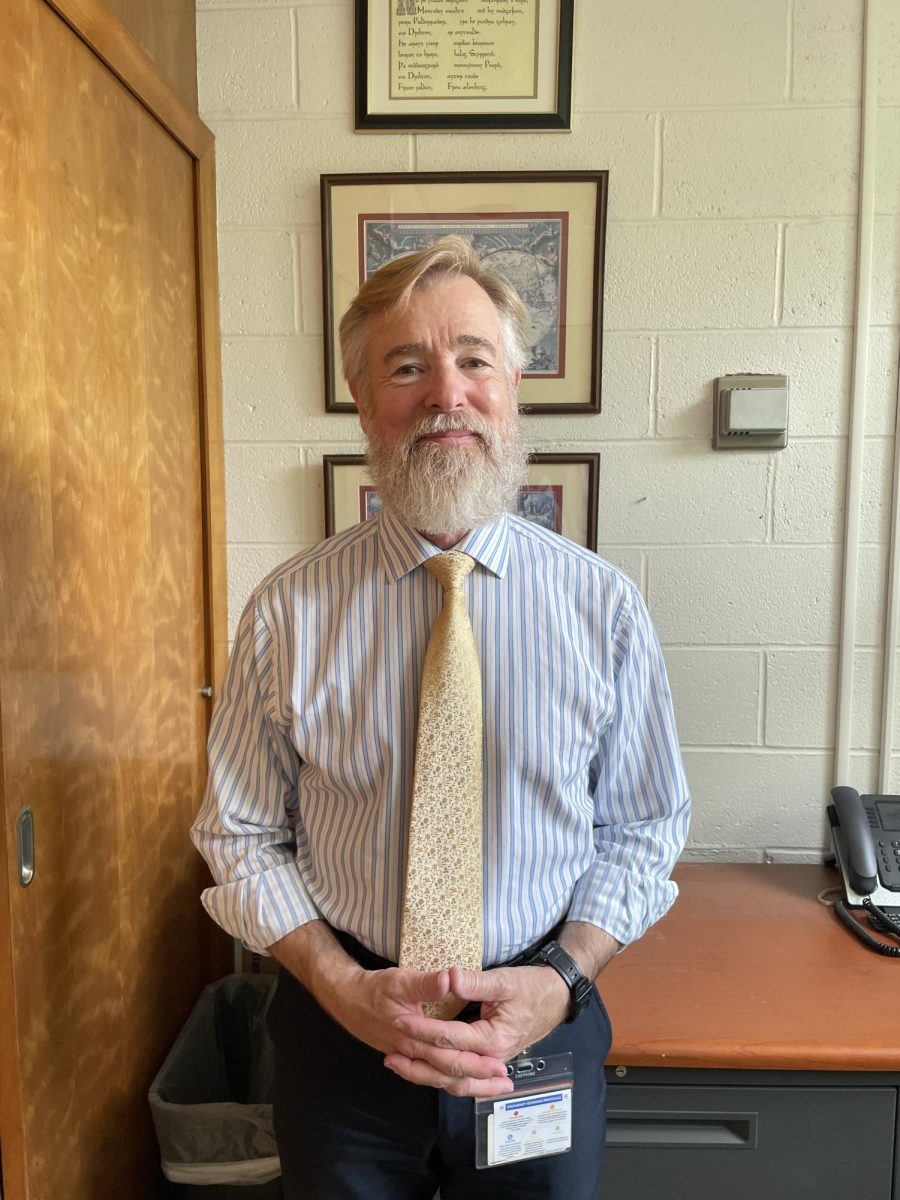
Dr. David Manuel taps the SmartBoard, and a sentence from the morning’s New York Times fills the screen. He steps back, arms crossed, and looks at the class expectantly. “Read it,” he says. “Carefully.” No one dares to move. The room is quiet in the way it usually is when no one wants to go first. Then a student blurts something out: “The subject-verb agreement is wrong!” Dr. Manuel tilts his head. “Close,” he says, but he knows the answer is not close at all.
The activity only takes up the first ten minutes of class—but within it represents everything Dr. Manuel has learned about teaching across four college campuses and a doctoral dissertation.
Before coming to South, Dr. Manuel worked as an Adjunct Lecturer at four colleges, including Adelphi University and Rutgers University. His teaching ran in parallel with his education: while he worked, he earned his Master’s in English Literature and a Ph.D. in English Literature from Rutgers University. However, South High remains Dr. Manuel’s first and only high school posting. After six years as an English teacher, Dr. Manuel became the English Department Chairperson.
When he arrived, however, some colleagues wondered whether a university instructor like himself could make the necessary adjustment to high school. University students choose their classes and pay to attend; high schoolers do not. While the actual course content, like teaching novels and analyzing poems, transferred without trouble, the classroom environment proved harder to recreate. “In the trenches, you figure it out,” Dr. Manuel said. “Some teachers never figure it out. They take [student resistance] personally, and they never connect with the kid.”
Dr. Manuel figured it out. He begins most classes with a do-now to pull students back into where they last left off before jumping into discussions—the contents of which will carry through the day’s material. To supplement this, he has also recently implemented a random name picker to eliminate bias within cold calling. This new method arose when he realized he was calling on boys more often than girls, without realizing it. The name picker pushed Dr. Manuel to think harder about which kids he was reaching and which ones he was missing. “You have to know your students… which ones are paying attention even though they aren’t saying anything, and the ones who aren’t paying attention because they don’t care or are too distracted,” he said. The strategy, he adds, always depends on the kid.
That attentiveness extends to his work as the English Department Chairperson as well. After years in classrooms, Dr. Manuel understands the importance of independence for his teachers. As chair, he sees his job as largely protective: He absorbs administrative duties so his teachers can keep their attention to their individual classrooms.
His duties at South High also reach into the Christian Seekers Club, where he advises the club but does not lead it. By law, he is only allowed to support the club’s student-led efforts without direct interference to maintain healthy boundaries. Without the weight of grades or a strict teacher-student relationship, he said, “you can talk to these kids about anything.” It is simply a “healthy relationship,” one that he values as much as anything that happens inside a classroom.
Dr. Manuel’s instinct for connection is a sensibility shaped by a deep passion for music and language that developed long before he ever set foot in a school. His father studied trombone at Juilliard on the GI bill while his mother worked as a pianist and organist. Following in his parents’ footsteps, Dr. Manuel grew up singing in church, joined the choir as soon as his voice changed, and studied voice seriously enough in college that music became a semi-professional, lifelong pursuit. Today, he conducts his church’s choir, and has earned the Honorary Life Membership in Tri-M Music Honor Society award for supporting music education, for example by coaching German to students for the school opera.
Language, too, has never left him. He arrived at Queens College as a German major, and his interest in etymology and grammar has stayed with him all these years. It is a fascination that has gained him notoriety—his students well acquainted with his grammar-rich puzzles, and his colleagues wholly familiar with the sentence structures he brings to their door mid-period.
In retirement, Dr. Manuel plans to finally indulge the curiosities he has long-postponed. First, he wants to surround himself with Biblical Greek. Although the language hasn’t been spoken in a conversational form for roughly 2000 years, Dr. Manuel isn’t bothered. “I’m not going to have to carry on a conversation with somebody,” he said. “Just a reading knowledge is fine.”
Beyond languages, he also hopes to deepen his involvement in his church, spend more time with music, and work through the library of unread books sitting at home. And most pressingly, he wishes to spend more time with his wife, who retired a few years ago and has already drawn up a list of activities. “She already has plans,” he said, smiling. “She hasn’t divulged them yet.”
When asked what he would want his students to carry forward, he doesn’t give a strict answer. Instead, he emphasizes flexibility. “Life is too short to pursue money as the purpose of life.” His own story—from choir singer to German major to university lecturer to English teacher—reflects that well. Pursue what you are passionate about, he said, but don’t be surprised if that passion shifts. It is a lesson passed down from his Milton professor, who told him that being an English major is “not about what you have read, but what you will read.” relayed the same message to him decades ago, and one he has lived by ever since—as proven by the pile of books waiting in his library. “Find something you love,” he said. “But be patient. The career builds.”