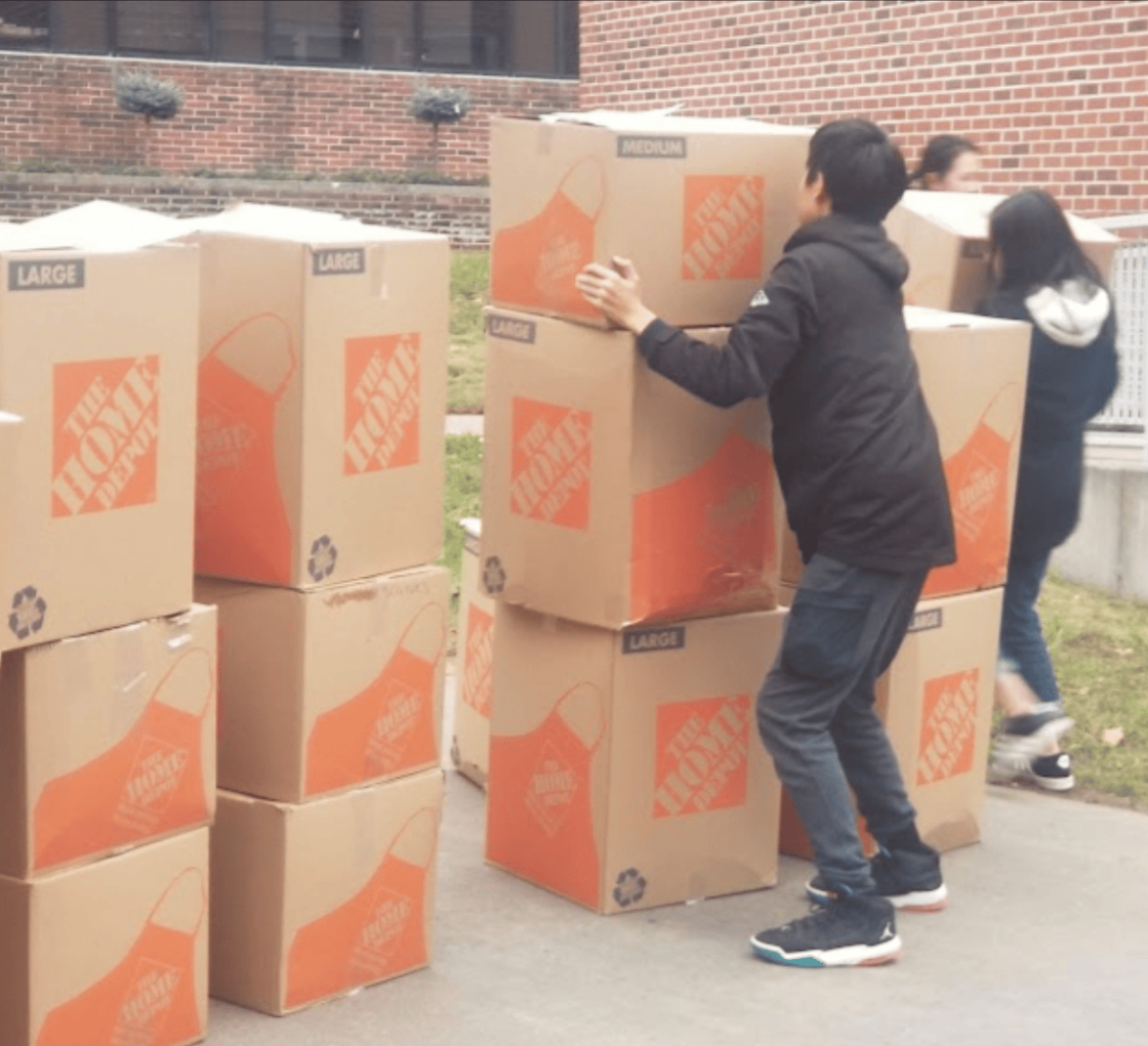
What do you picture when thinking about Great Neck South’s charitable efforts? You may visualize the Key Club’s blood drive, or maybe DECA’s fundraisers. What you likely don’t imagine is waking up at dawn, setting up a NYC soup kitchen, and seeing the joy of being given hot food and warm clothes. Organizing winter clothes and loading trucks with discarded items, destined for another life, likely doesn’t cross your mind. However, these activities are undertaken by one of our school’s greatest charity clubs: Midnight Run. Few remember that Midnight Run was one of the largest clubs in the school not so long ago. Even fewer know the absolutely vital charity work the club organizes in the shadows, unwavering in their goal to alleviate the struggles of the unhoused.
Midnight Run began in our school 18 years ago with a few passionate people who sought to do good in their community. Midnight Run is actually a nationwide organization with chapters in Denver, Newark, and New York City. It was brought to South by a student named Karen Zmora and the current advisor, Ms. Michelle Sorise. According to Ms. Sorise, “Originally, we used to bring kids to the temple, and we would do the run at the temple. [But] the club ended up becoming so popular that we [started] overtaking the temple.” In fact, South’s Midnight Run club was the first to be formed in a public high school.
As the club’s primary charitable effort, “runs” are impromptu soup kitchens set up in New York City where volunteers hand out hot food, warm clothes, and other essential goods. Midnight Run also collects donations and collaborates with organizations that seek to help people. For example, dress clothes go to Dress for Success; extra shoes go to Soles for Souls; and toiletries go to the Mary Brenner Inn.
Midnight Run has also accomplished efforts that required significant coordination. Their most significant effort was the donation of winter clothes to soldiers at Fort Drum, near the Canadian border. All in all, Midnight Run exemplifies the idea that one man’s trash is another man’s treasure. According to Ms. Sorise, “Whether it’s blankets or towels or toiletries or a fancy prom dress, we’ll see if we can find a home for items that people are looking to get rid of.”
Though Midnight Run has achieved so much, it does so with limited resources. For one, Midnight Run used to be amongst the proverbial Titans of clubs, but that all changed when membership decreased after COVID. Secondly, the club is limited by the available resources. Each individual run can cost upwards of $500 to buy fresh food, underwear, and other items that cannot be stockpiled. The club is also limited by how many items or how much money is donated. “Let’s say it’s a winter run, and I don’t have enough pants or jackets donated. It’s silly for us to go into the city and have all these people come up to us and ask for [items] we don’t have,” said Ms. Sorise.
Perhaps the greatest limiting factor is the availability of students. Midnight Run is a student-run club that relies on students having time not only to go on the runs themselves, but also to prepare for them by collecting items, organizing donations, and holding fundraisers.
Despite these issues, Midnight Run prevails.. Ms. Sorise has started planning runs for Columbus Day and other holidays to increase student participation.
Yet the effects from the Covid Era continue to be felt. With so few members, very little can be done. “It’s not like we can just go on a run—the legwork, the coordination, the money requires effort from the [students],” said Ms. Sorise. In addition, the club continues to lack certain supplies needed for these runs, as donations from students have decreased.
If Midnight Run is to reach full potential, it needs students to become involved again. For Ms. Sorise, the real driving force behind the club is the students, “I would say it’s the kind of club that what you put into it is what you get out, and if people are willing to put in the work, then it can be one of the most rewarding things they’ll ever do.”