At two years old, Herman Li was a nightmare.
And sadly for his parents, rather than a quiet-and-quick-in-the-corner nightmare, he was a dashing-between-opposite-ends-of-the-house and won’t-stop-until-in-deep-REM-sleep nightmare.
To remedy this issue, Herman’s parents came up with a genius idea: plop him down at a Taekwondo gym to channel his energy into something productive. The sturdy floors, open space, and lack of breakable objects in arms reach meant he could burn all the energy he wanted without risk. Soon, this nightmare became a dream.
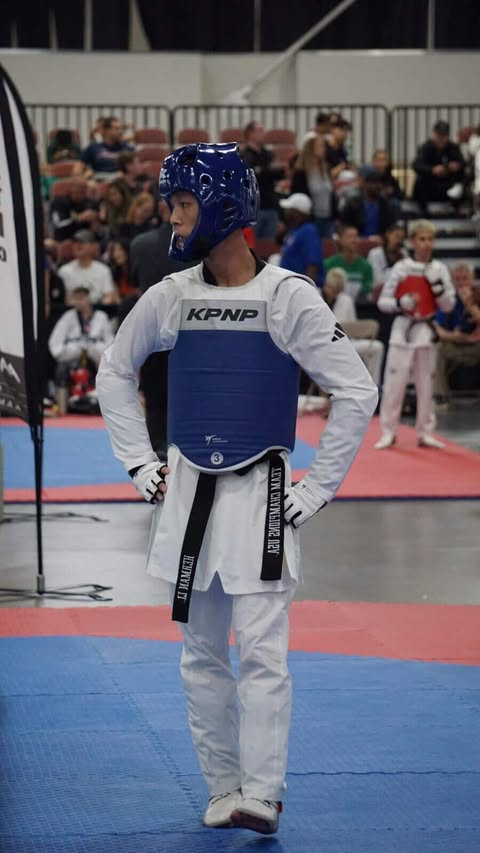
By the time he turned nine, Herman had been casually doing Taekwondo for seven years, long enough for his relentless and seemingly unending energy to turn into genuine passion, a fiery drive that was noticed by a professional coach. “That was when I realized I could have a future with the sport,” said Herman. “Plus, I found Taekwondo to be fun and something that fit my personality really well.”
From there, the wins were unending. A black belt and first national title at ten. International competitions at eleven. By 2022, Herman had made the national team and was racking up titles for the US at competitions like the Pan Americans and the Taekwondo Sweden and Mexico Opens.
Now, Herman Li is a junior at South High, and is caught endlessly between classroom SmartBoards and Taekwondo wooden boards. By 3 pm., Herman has already slid out of his school clothes and into his Taekwondo Dobok, trading school attire for gym attire, graphite still smudging his fingers as he hits the mat. Although the split has been steadily present since elementary school, an increase in course rigor and the looming stress of college is forcing Herman to constantly redraw his boundaries. To some, these two lives seem incongruous, incompatible for a healthy and balanced life. But to Herman, the choice isn’t hard: Taekwondo is the priority.
When the final bell at South High rings, Herman goes straight to the Taekwondo gym. As a member of the U.S. national team, his training is regimented. He spends nine hours at the gym, his practice split into three blocks of two hours with breaks in between.
But unlike school athletes, Herman doesn’t have an inherent support system. Taekwondo doesn’t have a physical therapist on hand next door, nor does it have paid buses to take anyone anywhere. No pep rallies or events that sustain spirit, no friends that extend from school into sports—for Herman they are markedly separate. So out of necessity, Herman has built his own support system.
Academically, Herman is always trying to find the right balance. Homework and projects are usually crammed into free periods or downtime within the school schedule. And at the gym, echoes of splintering wood hitting the floors is often followed by frantic scribbling on Geometry homework during breaks. Quiet rides home can also turn into impromptu science experiments. Herman’s social life happens primarily in the Taekwondo gym too. “I hang out with friends whenever my coach gives the team days off,” Herman said. “But since I have grown up with the people at my Taekwondo school, it feels like I’m living my social life there since I have formed such deep friendships.” Besides his friends, his coach, parents, and Taekwondo mentors sustain him—the people who comfort Herman after a hard loss.
Because the hardest part of Taekwondo for Herman isn’t the six hour training days, it’s the mental fortitude needed to keep up.
In 2024, Herman moved up to juniors—the 15-17 division—where everyone seemingly had at least three inches and three more years of training than he did. For the first time, he seriously thought about quitting. “After a loss, it’s hard to bounce back with the same mentality and passion,” Herman said. “I would close myself off from people and just want to be left alone.” The same circle he built inside the gym became the one that pulled him through. And after competing in Worlds again, that same passion from the early days has come back. “I want to strive to be the best. Winning this Worlds is my biggest goal in my Taekwondo career that I wish to accomplish.”
Herman’s path forward is clear: keep going. As long as the passion remains, he’ll chase the world championship with the same principles that have sustained him since he was a running-up-and-down-the-walls toddler: “The most important lessons I’ve learned from Taekwondo are discipline, courage, and respect. I carry those values not just in the studio, but in everything I do.”