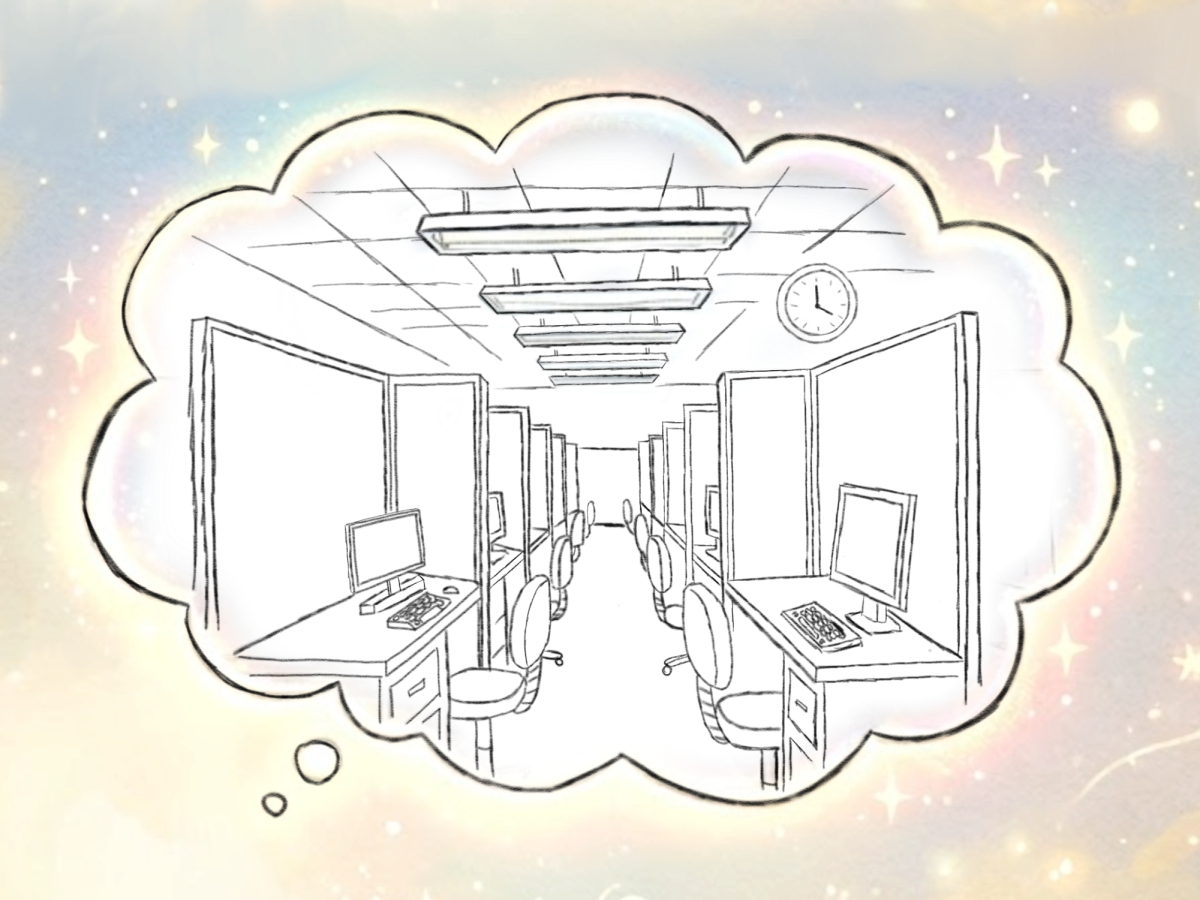
What’s in a 9-to-5 job anyway?
Fluorescent lights, probably. Coffee. Slouching in a cubicle while watching Microsoft Copilot do your work mildly incorrectly. What comes after you clock out? A cold apartment ($). Mediocre dinner for one. Grappling with the inevitability of seeing that irritating colleague tomorrow.
Fine, I’m being dramatic. Maybe you have an office instead of a cubicle, and maybe your rent is surprisingly reasonable, and maybe your dinner is pretty good. But this hypothetical isn’t complete silliness. Many of us have encountered and subconsciously internalized this stereotypical, half-joke-half-warning depiction of adulthood from somewhere. It seems like a distant caricature on most days, but sometimes I question my dismissal. As time creeps by and the concept of a career becomes more real, I wonder: How do we mature without losing ourselves?
Actually, let’s take a step back. Maturing doesn’t necessitate losing anything. However, many aspects of adulthood encourage us to succumb to the easy way out. What’s the point of thinking critically at a job when your only goals are to complete tasks and to collect a paycheck? Unlike in school, there exists no governing structure pushing you to grow for growth’s sake; you lose the consistent and assisted routine of enrichment foisted upon you by the school system. Without external pressure, ennui sets in quickly.
And there exists a more insidious worry: What if adulthood isn’t so different from high school? Pressure-cooker school culture tends to encourage results-based approaches where outcomes precede processes and values. Anything for the grade, right? What if the worst of our high school mentality informs our approach to life? What if money ends up simply supplanting grades?
Logically, I fear this possibility, so I want to fight it. But sometimes, it feels so easy to give in and accept that jadedness and expediency accompany maturity. On my worst days, I conflate maturity with ennui. I wonder if growing up means the dulling—voluntary or not—of emotional and intellectual intensity. Broad assumptions inform my most pessimistic states of mind, and I often don’t even notice. The first: that learning has a natural endpoint, and that that endpoint falls somewhere around the end of formal schooling. Afterward, learning becomes an indulgence for which you must trade something else. The second: that it is unwise to partake in anything without immediate utility to your goals unless you’re taking an unquestionably necessary break.
Both assumptions are wrong. And I think, on better days, we all know it.
The learning-ends-with-school assumption falls apart when you interrogate it. What does it mean for learning to “end”? Sure, at some point you stop being formally evaluated. But you also keep encountering problems you don’t know how to solve, people you don’t understand, and situations that resist your existing frameworks. The act of learning does not disappear, but nobody explicitly prescribes it to you anymore. Take your newfound freedom to, for the first time, choose how and what you learn completely on your own. Return to the things you loved before academic stress buried them—Wikipedia rabbit holes, books read for fun, “stupid” questions asked for the sake of asking. And a little utility is great: Learn how to solve new problems and understand new people for the sake of your career advancement or your interpersonal skills. Reject the burnt-out, pressure-cooker mindset that has trained us to be passive recipients of knowledge. Neither learning nor curiosity have a natural endpoint.
The utility assumption is harder to shake because it can be true. Time is finite, and not everything is worth doing. But don’t constrain yourself to doing things only with a measurable payoff; be selective. Many of the things that changed how I think came upon me as coincidences—funny-looking articles, unexpected conversations, and seemingly unjustified interests. However, usefulness is very hard to predict. Trying to pre-screen your experiences for utility will probably do more harm than good. Furthermore, taken too far, an obsession with utility eliminates everything that makes your life feel worth the effort. Why work hard if you can’t enjoy it later? What are you going to do with all that money? It becomes much harder to keep working without the occasional comforts of wonder and novelty. Curiosity promotes personhood, and without our personhood, what are we?
I don’t advocate for some relentless self-improvement project. This obsession tends to equally ignore the value of processes in favor of results. Instead, I want us to stay permeable. Leave yourself open to curiosity if it finds you. Let things matter to you, even if they feel initially inefficient.
I was a more joyful, curious person before stress set in. I don’t think that’s an irreversible loss, but I also don’t think I’ll regain my verve automatically. So here’s what I wish for everyone—and really for myself: Don’t let the worst-case adulthood win by default. Fight it with small, stubborn acts of staying responsive and open. Care about something you’ll never be tested on; be amazed by something stupid and wonderful. The fluorescent lights and irritating colleague may well be coming. But they don’t get to be the whole story unless you let them.