It’s 7:58, and you’re speed-walking to chemistry from the upper cafeteria, where you just purchased a much-needed iced coffee. As you’re passing the library, another student rushes out and collides with you—and your coffee. $0.75 worth of revitalizing caffeine pours onto the floor. Your mind spirals as you consider whether you should clean up—and risk facing an unexcused “tardy” and your teacher’s disappointment—or just move on. With the three milliseconds you have to think, you choose to prioritize your class. You brush off concerns about students tripping and focus on the covalent bond you’re about to form with this material.
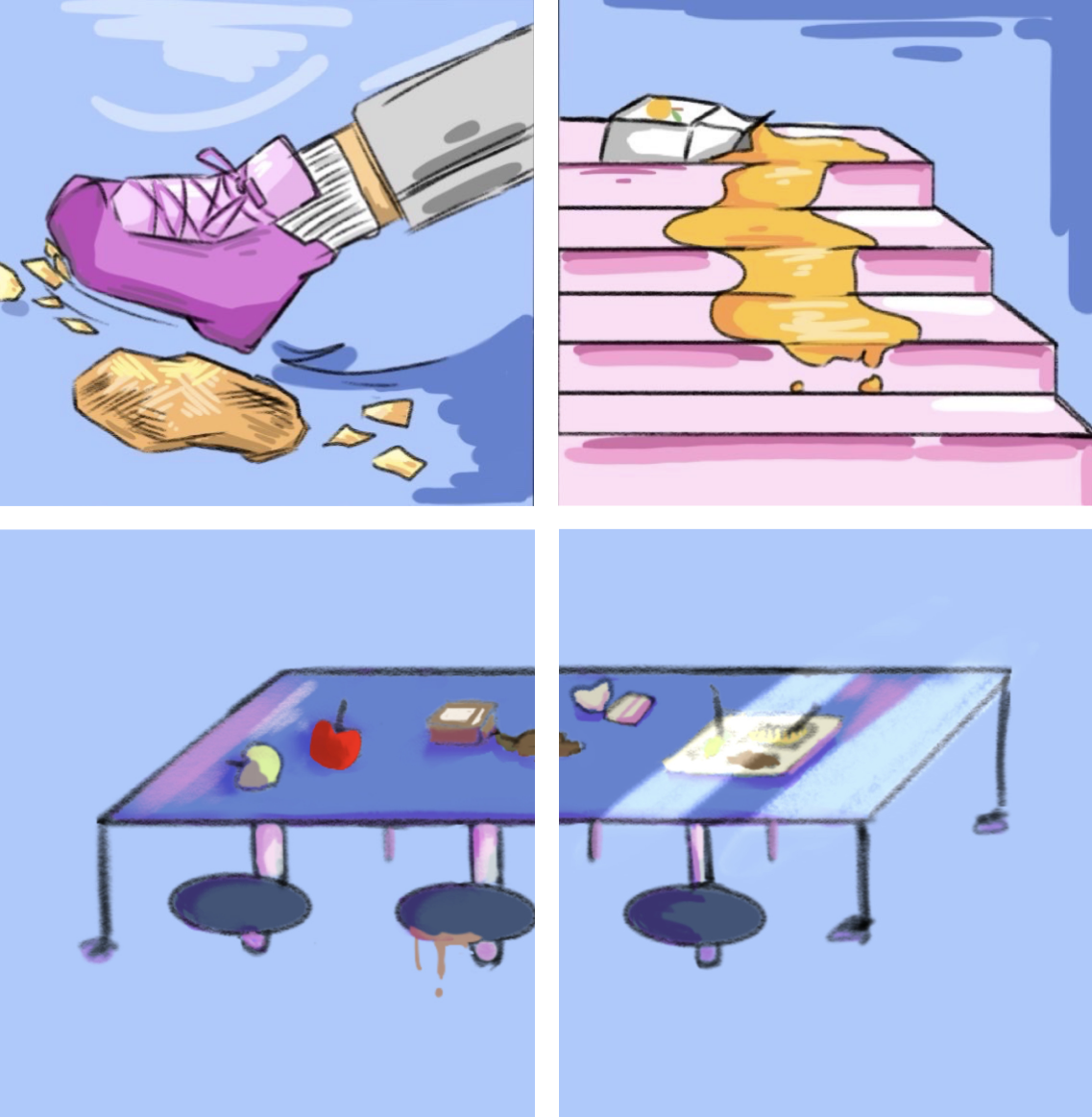
Leaving behind spilled food has become increasingly common in South’s hallways, with Alfa Husbands, a custodian with 26 years of experience at our school, remarking that it now occurs “practically every day.” The new policy of free lunch and breakfast causes more students to bring food out of the cafeteria, in part, contributing to the cycle. We’re so caught up in our own experiences that we often don’t consider how a moment of clumsiness or carelessness will impact others. Seeing students leave strips of bacon on the stairs gives us implicit permission to do the same when we drop our brownie.
It’s understandable why we think this way. When juggling classes, sports, and extracurriculars, this mindset becomes easy to adopt and normalize. We’re also privileged to have staff who care in place of us. Sometimes, our consideration inevitably takes a back seat to other priorities—until we’re the ones slipping on salad or tracking mashed-up hash browns down the stairs.
The consequences of our decisions aren’t limited to us; they affect the rest of our school environment as well. When teachers are aware of the situation, they take time away from class to call security about the spill. Security then notifies the custodians. “We respond to it right away, as fast as we can, because we know it is a potential danger to students and faculty,” said Mr. Husbands.
For students, these spills cause traffic that makes them late to class or, worse, cause injuries. “Spills are dangerous to other kids because we have had kids slip in the past on water, soda, juice, and food,” said Mr. Husbands. Students may also bump into others while trying to avoid the mess.
In a situation where our actions affect the rest of the school, if everyone stops and cleans up, perhaps next time you won’t be the one swerving to avoid a brownie on the floor. First, check if it’s manageable to clean up by yourself. If you’ve dropped solid food like lettuce or green beans, get paper towels from the nearest bathroom and clean up by yourself. Otherwise, notify a teacher immediately. Even if you’re late to your next class, teachers understand mistakes happen and will hopefully be amenable if you explain yourself.
Greater conscientiousness about your food will also help prevent these situations in the first place. If each of us puts more care into how our actions affect the rest of the school, we will help uplift and support each other. This mindset carries over into other facets of our school experience. In the library, we should be mindful of our volume to lessen distractions for focused students. In bathrooms, we should treat stalls with respect. All of us attend this school together—let’s make it a place we can appreciate.
The respect we show to our school environment is just as essential to South High’s culture as our school spirit or our grade-driven students. Respecting our camaraderie in attending this school together is the first step in bettering our outlook. Each of us faces the same experiences that define Great Neck South—let’s ensure that these experiences don’t include student-caused disruptions. Through greater consideration, we can cultivate a more thoughtful, unified environment.