The Oscars, Explained (Before We Hand Out Our Own)
Every year around this time, the internet collectively pretends it has always cared deeply about cinema. Group chats light up. Timelines argue. Someone suddenly becomes an expert on cinematography. And then—like clock work—the Oscars return.
But before we start deciding our winners, let’s rewind for a second. What are the Oscars anyway? Who decides? And why does it feel like the rules change every year?
A Very Brief (But Necessary) History
The Academy Awards—better known as the Oscars—were first held in 1929, back when movies were silent, black-and-white, and somehow still dramatic. They were created by the Academy of Motion Picture Arts and Sciences (AMPAS), an organization made up of film professionals who wanted to honor “excellence” in filmmaking. (What counts as excellence is… still up for debate).
What started as a private dinner has turned into one of the biggest nights in entertainment: red carpets, speeches that go on too long, speeches that end too fast, and at least one moment each year that becomes a cultural reference forever.
Winning an Oscar isn’t just about bragging rights. It can change careers, boost box office numbers, and cement a movie’s place in history. Or, occasionally, it can just confuse everyone.
So… How Does This Actually Work?
Despite how personal people take it, the Oscars are not decided by vibes alone.
The Academy is made up of thousands of members, all working in film: actors, directors, writers, editors, costume designers, and more. Each branch nominates within its own category (actors nominate actors, directors nominate directors, etc.), while Best Picture is nominated by members across the board.
Once nominations are announced, everyone votes on the winners. Most categories go to the nominee with the most votes, while Best Picture uses a preferential ballot—which is fancy language for “rank your favorite and let chaos math decide.”
The Oscars Have Been Changing (Whether You Like It or Not)
In recent years, the Academy has been forced to look inward. Criticism about diversity, representation, and relevance hasn’t been quiet—and the Oscars responded.
New representation and inclusion standards were introduced for Best Picture eligibility, encouraging films to include underrepresented voices both on-screen and behind the scenes. The Academy has also expanded its membership, inviting younger and more international filmmakers to vote, which has slowly shifted what kinds of movies get recognized.
Streaming films—once treated like the enemy—are now regular contenders. A movie doesn’t need a months-long theatrical run to be “serious” anymore. If it makes people feel something (or argue online), it’s in the conversation.
Translation: this year’s nominees may look very different from Oscars the of ten—or even five—years ago.
Why People Still Care (Even When They Say They Don’t)
The Oscars are flawed. They miss things. They snub performances that deserved everything. They reward movies you’ve never heard of and ignore ones you loved.
And yet—we watch.
Because the Oscars aren’t just about movies. They’re about taste, culture, and who gets to decide what matters. They spark debates, inside jokes, and opinions so strong you’d think someone personally edited the film.
Which brings us to the most important part. If the Academy gets a vote… why shouldn’t we?
Next up: The Southerner’s Oscar Picks—where we take Hollywood’s nominees and decide who actually deserves the trophy.
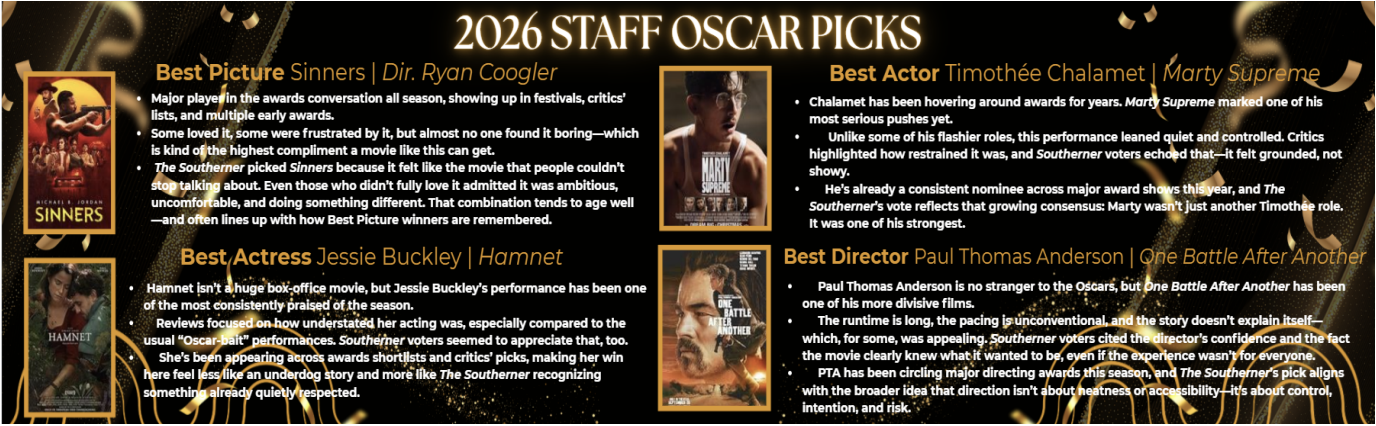
Best Picture: Sinners
Sinners is long. Like, over two hours and a half long. And yet, one of the most common responses from voters was that it earned its runtime.
The film has been a major player in the awards conversation all season, showing up at festivals, critics’ lists, and multiple early awards. Some people loved it, some people were frustrated by it, but almost no one found it boring—which is kind of the highest compliment a movie like this can get.
The Southerner’s picked Sinners because it felt like the movie people couldn’t stop talking about. Even those who didn’t fully love it admitted it was ambitious, uncomfortable, and doing something different. That combination tends to age well—and often lines up with how Best Picture winners are remembered.

Best Actor: Timothee Chalamet (Marty Supreme)
Timothee Chalamet has been hovering around award seasons for years, but Marty Supreme marked one of his most serious pushes yet.
Unlike some of his flashier roles, this performance leaned quiet and controlled. Critics highlighted how restrained it was, and Southerner voters echoed that—it felt grounded, not showy. No big monologues clearly engineered for Oscar clips. Just a fully realized character carrying the film.
He’s already a consistent nominee across major award shows this year, and The Southerner’s vote reflects that growing consensus: this wasn’t just another Timothee role. It was one of his strongest.

Best Actress: Jessie Buckley (Hamnet)
Hamnet isn’t a huge box-office movie, but Jessie Buckley’s performance has been one of the most consistently praised of the season.
Reviews focused on how understated her acting was, especially compared to the usual “Oscar bait” performances. Southerner voters seemed to appreciate that too. A lot of responses mentioned how natural and unforced she felt, and how the movie relied on her emotional control rather than dramatic spectacle.
She’s been appearing across awards shortlists and critics’ picks, making her win here feels less like an underdog story and more like The Southerner recognizing something that’s already quietly respected.

Best Director: Paul Thomas Anderson (One Battle After Another)
Paul Thomas Anderson is no stranger to the Oscars, but One Battle After Another has been one of his more divisive films.
The runtime is long, the pacing is unconventional, and it doesn’t explain itself—which, for some viewers, was the appeal. Southerner voters cited the confidence of the direction and the fact the movie clearly knew what it wanted to be, even if that wasn’t for everyone.
PTA has been circling major directing awards this season, and The Southerner’s pick aligns with the broader idea that direction isn’t about neat or accessible—it’s about control, intention, and risk.