Sitting in bleachers atop the stage, the audience is faced with a minimalistic set: a black wall with a couple doors. And yet, in the hands of ten different students, the world on that stage changes five-fold.
A luxury train car.
A futuristic facility.
A Russian household.
…an awfully familiar Psych classroom? And was someone having a breakdown over biscuits? It’s confusing, it’s riveting, it’s overwhelming. It’s the One-Acts.
The One-Act Festival, or simply One-Acts, is a series of short, one-act plays that can range from 15-45 minutes each. While Ms. Ilana Meredith directs the other Theatre South productions (e.g. fall musical, winter play), the One-Acts are special because they are directed by students. Each one-act is directed by a student pair, a senior and either another senior or a junior. Typically, these directing duos choose their play from one-act websites, though they can also direct an original play that they wrote.
Um, I Think the Psych Teacher is Dead
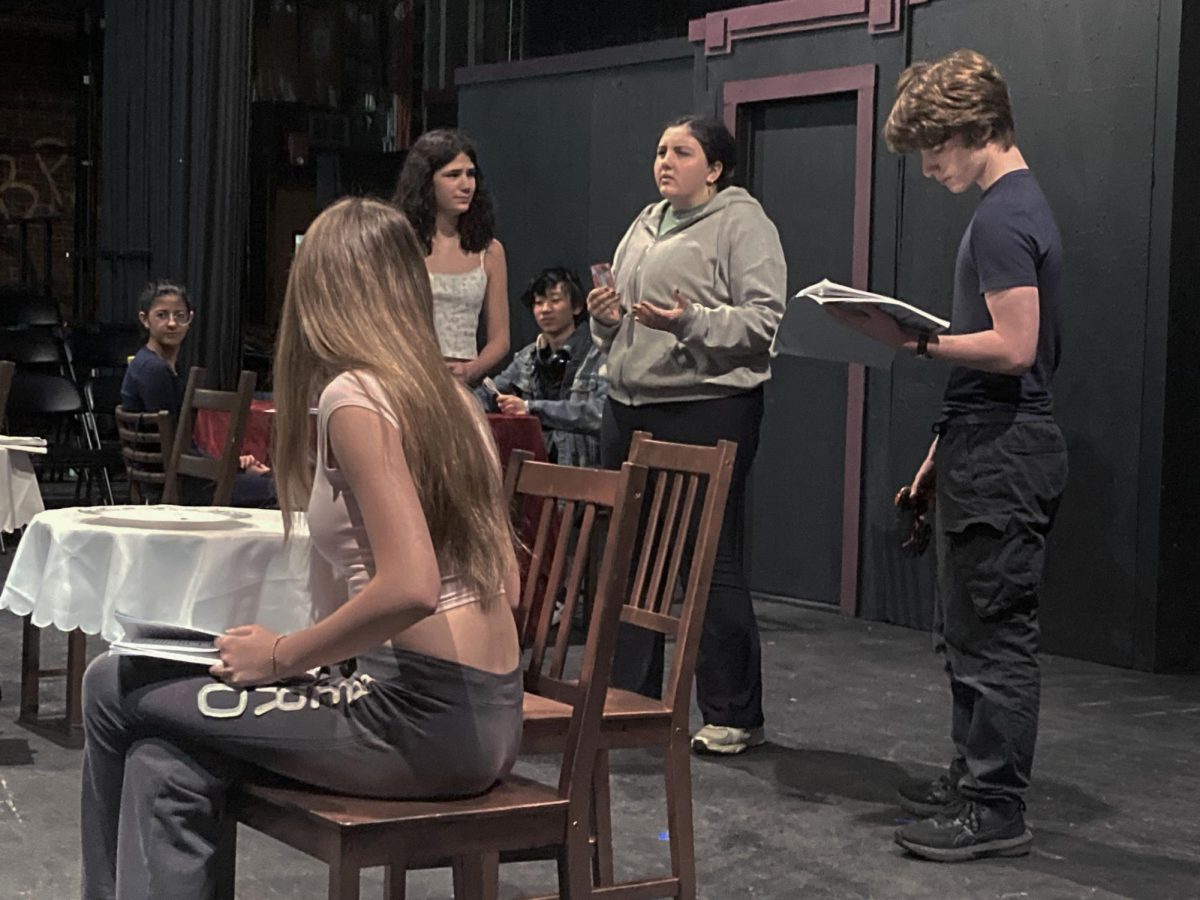
Students trickle into Mr. M’s (Bryce Kohler’s) Psych class for their final, all absorbed in their own plotlines: the charismatic Boy Next Door (Annette Luk) attempts to prom-pose to the Rules Follower (Olivia Kang), who’s too busy deciding when she should have a panic attack; Cheerleader (Chaya Root) is obnoxiously live-streaming as Jock (Iris Du) attempts to memorize the answer key; the uptight Salutatorian (Anyi Gu) is lamenting about the possibility of getting a 90 to the Tough Kid (Ye Chen), who predicts a 40 for himself.
Filled with many other quirky characters and plot twists, Um, I Think the Psych Teacher is Dead tells a Lord of the Flies-esque story of students left stranded in their psychology class, faced with their final, their personal dramas, and the corpse of their beloved (and awfully familiar) Psych teacher.
Directed by Addie Suggs and Madilyn Chan, Psych Teacher sports the largest cast — fifteen students — out of the One-Acts, an intentional choice on the directors’ parts: “We have both been in really big shows before, and … at least for me, it’s that kind of ensemble feeling that’s what I love so much about theater,” said Suggs.
Besides a bigger ensemble, Suggs and Chan both knew that they wanted a longer and more comedic play. While scrolling through a list of possible shows, Chan saw the play’s title and “just knew.” Drawn in by the title, they both read the script and were taken by the humor and quality.
One of the bigger obstacles Suggs and Chan faced was the staging. Since the one-act is primarily set in a classroom, the entire cast is onstage essentially the whole time. This leads to conflicts, such as balancing a scene so that a certain interaction between two characters is well-emphasized. There are multiple instances in this play where two characters are having an important interaction while everyone else is either doing something else or reacting to said interaction. The challenge here is positioning the rest of the cast to place emphasis on these two characters, and finding a balance in their reactions to avoid subtracting from the interaction they are witnessing.
The Past Lives of Sadie Baker
Imagine you were once a 20 year-old with dreams and aspirations. Now you’re 30, long past your prime, and lacking the ambition and hopes of a younger you (a discourse not unheard of with seniors and even South alumni). But ten years’ worth of technological advancements allow you to return to a moment in your past, change your decisions, and watch what your life could have been like. Sadie Baker (Chantalle Delson) uses this technology, assisted by an AI Narrator (Samuel Bernstein), to go ten years back to the moment when a bright twenty-year-old Sadie (Sofia Gurtman) is at her Papa’s (Emma Condello’s) bedside, as he slowly passes away.
The Past Lives of Sadie Baker is unique in this year’s batch of One-Acts in that it is an original play written by directors David Bernstein and Phoebe Mark. The writing process started only around two months ago and persisted into rehearsals until Bernstein and Mark were satisfied with their final script.
This year’s one-acts have a balance across comedy, drama, and introspection, and this show definitely highlights the last of the three. “One of the biggest themes is actually something that directly relates to me and Phoebe as seniors, as well as everyone else in the world, [it being] the importance of huge decisions that you have to make in life, and how they affect you for the rest of your life,” said Bernstein. This theme is seen all throughout the show, from the service of changing your past decisions, to Sadie’s decision to see these alternate pathways, and to the climactic decision she has to make at the end of the play, which will entirely change the course of her life.
Biscuits
Biscuits. A rather innocent word, by itself. Depending on who you ask (i.e. me) they are simply boring cookies. Yet, in this One-Act, they become a weapon. Biscuits. The path Daniel has gone astray from. Biscuits. They built the roof over Charles’ head. Biscuits. They’re crumbling down all around them. Biscuits. The weight passed from father to son, generation to generation, pressing down upon them all.
Directed by Anishka Arolkar and Rachel You, Biscuits follows Daniel (Sofia Gurtman), fresh out of college, returning home with his girlfriend Thalia (Iris Du) to his father Charles’ (Maximillion Corrales’) house, who expects him to take on the family business: biscuits.
Like Sadie Baker, Biscuits is driven by themes current both to seniors and the world around us. “[Biscuits is] very representative of what it’s like — especially for the seniors as you go into college — navigating your own path, figuring out things that you want to figure out and making a future for yourself …especially at a school like Great Neck South where you have so much pressure from parents, teachers, [and] students to go for the greatest thing and do what a lot of people other people tell you to do,” said Arolkar. “Biscuits is a show about trying to step away from that and figuring out your own self, and it’s like a son and father relationship, and I think that’s really interesting.” Besides the idea of moving into a different stage of life, Biscuits also demonstrates generational trauma. More popular media, especially in the last few years, has been depicting the weight of generational trauma, and Biscuits doesn’t shy away from showing how a burden has been passed on from generation to generation, especially when the next successor is unwilling.
The Emerald Heist
Mystery! Drama! Action! Where has the emerald gone? Who stole it?
Oh, perhaps I should rewind a bit.
The story unfolds within a moving train, no way in nor out. A pair of mysterious misfits (Juliana Salcedo and Aaron Liu), a rich yet generous woman (Chantalle Delson), a shifty thief (Samuel Bernstein), a marshal (Ava Isopo), a suave jeweler (Olivia Kang), and a museum curator (Annette Luk). And of course, the titular emerald ring, all in the first class stage coach. Whatever could go wrong?
The Emerald Heist is directed by Alyssa Sheti and Anya Patel, who chose their play to maintain the theme of illegal activities in Theatre South’s productions this year: “We had Guys & Dolls, and that’s underground illegal gambling; we had Clue, and it was this whole murder, which is just obviously wrong. [We wanted to] keep the theme [of illegal activities] going. And we found a heist,” said Patel. Sheti and Patel were initially worried that Emerald Heist would be too repetitive with this theme and the rest of the One-Acts, but they knew they wanted a play with action, and the variety and creative usage of props convinced them.
The Proposal
“…grandfather was a drunkard, and your aunt ran away with an architect!”
“And your mother was hump-backed!”
“Your father was an addicted gambler!”
“And there haven’t been many evil gossipers to equal your aunt–-that lying bi…”
These are just a few of the choice sound bites from Chubokov’s home, after he and his daughter Natalya had a “friendly disagreement” with their neighbor Lomov.
The Proposal is a short play written by famous Russian playwright Anton Chekhov and directed by Jonathan Wu and David Kagan. It follows Ivan Vassilevitch Lomov (Neil Marantz) attempting to court his neighbor Natalya Stepanovna (Juliana Salcedo), with the support of her father Stepan Stepanovitch Chubokov (Jackson Ranada-O’Mara).
Wu and Kagan have been doing theater together since sixth grade and feel that “It’s very nice to be able to finish our high school theater careers working together on one more show even if we’re not … on stage starring, we can put our experience into making this the best show it could [be],” said Wu. Both directors placed a great emphasis on the importance of memorizing the piece as soon as possible, so their actors would be able to capture the nuances and satires that Chekhov presents in his writing.
The One-Acts are always a mixed bunch; many (e.g. Emerald Heist, The Proposal, Psych Teacher) evoke laughter through exaggerated caricatures and circumstances, while some like Sadie Baker and Biscuits are slower dramas that make their audience think — each year, there’s something for everybody. This year’s One-Acts were extra special because they were the last major Theatre South production on the current stage, since the auditorium will be closed for renovation for at least the next academic year. Fittingly, these one-acts served as a farewell to both the participating seniors of Theatre South and the Ruel E. Tucker Auditorium, as we know it.